

 QMS & Global Regulatory Services
Clinical evaluation
As per MEDDEV 2.7/1 Revision 4, Clinical Evaluation is defined as: A systematic and planned process to continuously generate, collect, analyse and assess the clinical data pertaining to a device in order to verify the safety, including clinical benefits, and performance of the device when used as intended by the manufacturer. Performing a clinical evaluation is essential for medical device companies to demonstrate safety and performance compliance of their device in Europe.
Relationship with Risk Management and Post-Market Surveillance
Clinical evaluation is closely linked to risk management and post-market surveillance activities. Clinical risks identified during the evaluation process are incorporated into the Risk Management File, while post-market data provides ongoing evidence regarding device safety and performance.
As new clinical information becomes available, the clinical evaluation should be reviewed and updated to ensure continued compliance and maintenance of a favourable benefit-risk profile.
Clinical Evaluation Plan (CEP)
Clinical Evaluation Plan (CEP) establishes a structured approach for planning and conducting the clinical evaluation of a device throughout its lifecycle. The purpose of a CEP is to define how clinical evidence will be collected, assessed, and analyzed to demonstrate that a medical device achieves its intended purpose while meeting applicable safety and performance requirements.
Why is a Clinical Evaluation Plan Important?
A Clinical Evaluation Plan serves as the foundation of the clinical evaluation process. It helps manufacturers:
- Define the scope and objectives of the clinical evaluation.
- Identify applicable General Safety and Performance Requirements (GSPRs).
- Establish clinical performance and safety claims.
- Determine sources of clinical evidence.
- Assess the benefit-risk profile of the device.
- Support regulatory compliance under EU Regulations.
Key Elements of a Clinical Evaluation Plan
- Device Overview: The CEP begins with a detailed understanding of the device, including its intended purpose, mode of action, design characteristics, and regulatory classification.
- Intended Purpose and Users
- Clinical Claims
- Benefit-Risk Assessment
Two Key Approaches to Generating Clinical Evidence
Clinical evaluation may rely on existing clinical data, require the generation of new clinical data, or combine both approaches. The appropriate strategy must be justified based on the device-specific evidence needed to demonstrate conformity with the MDR.
Literature-Based Clinical Evaluation
A literature-based clinical evaluation uses relevant published scientific literature and other available clinical data to assess the safety, performance, and clinical benefits of a medical device.
The evaluation may include clinical data relating to the device under evaluation, an equivalent device where equivalence can be adequately demonstrated, or relevant clinical experience reported in scientific literature.
The process generally includes:
- Defining the scope and objectives of the clinical evaluation.
- Developing a systematic literature search strategy and protocol.
- Identifying relevant published and available clinical data.
- Critically appraising the methodological quality, scientific validity, and relevance of the identified evidence.
- Assessing clinical safety, performance, clinical benefits, undesirable side effects, and the benefit-risk profile.
- Identifying gaps in the available clinical evidence.
- Documenting the findings and conclusions in the Clinical Evaluation Report (CER).
A literature-based approach may be appropriate where the available clinical evidence is sufficiently robust, relevant, and applicable to the device's intended purpose and characteristics.
However, literature evidence alone is not automatically sufficient. The manufacturer must demonstrate that the totality of clinical evidence adequately supports the applicable GSPRs and the device's clinical claims.
Clinical Evaluation Supported by a Clinical Investigation
A clinical investigation is a systematic investigation involving one or more human subjects undertaken to assess the safety or performance of a medical device.
A clinical investigation may be necessary when existing clinical evidence is insufficient to establish the device's safety, performance, or clinical benefits, or when important evidence gaps remain after evaluating the available literature and other clinical data.
Clinical investigations can generate device-specific clinical evidence to address questions such as:
- Does the device achieve its intended clinical performance?
- Are the claimed clinical benefits supported by objective clinical outcomes?
- Are the identified risks and undesirable side effects acceptable?
- Does the benefit-risk ratio remain acceptable under the intended conditions of use?
- Are there uncertainties that cannot be adequately addressed using existing clinical evidence?
The investigation should be appropriately designed and conducted in accordance with the applicable MDR requirements, including Article 62 and Annex XV. Relevant ethical, scientific, and regulatory requirements must be addressed.
The resulting clinical data are critically evaluated and incorporated into the Clinical Evaluation Report, together with other relevant evidence.
Clinical Evaluation Approach depending on the Risk Class?
The device's risk class is an important factor in determining the clinical evidence strategy. However, the EU regulation does not establish a simple rule that Class I devices require literature evaluation while Class IIa, IIb, or III devices always require clinical investigations. The manufacturer must justify the level of clinical evidence needed in accordance with Article 61(1), taking into account the device's characteristics and intended purpose.
| Device classification | Clinical evaluation considerations |
|---|---|
| Class I | A clinical evaluation is required. Existing clinical data and scientific literature may be sufficient where they adequately demonstrate conformity with the applicable GSPRs. |
| Class IIa | The clinical evaluation must provide sufficient evidence to support the intended purpose, safety, performance, and clinical benefits. Existing evidence may be used where adequate; additional clinical data may be necessary. |
| Class IIb | The clinical evaluation generally requires a more extensive assessment of clinical evidence proportionate to the device's risks and intended purpose. The need for new clinical data must be assessed and justified. |
| Class III | A comprehensive clinical evaluation is required. Article 61(4) generally requires clinical investigations for implantable and Class III devices, subject to the specific exceptions and conditions provided in Article 61(4) - (6). |
Sources of Clinical Evidence
Clinical evidence may be obtained from various sources, including:
- Scientific literature
- Clinical investigations
- Equivalent device data
- Post-market surveillance information
- Risk management documentation
- Verification and validation reports
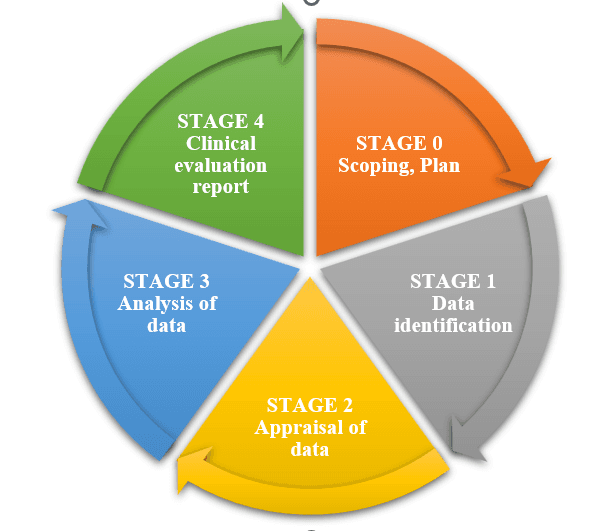
Stages of Clinical Evaluation
The clinical evaluation process typically follows a systematic approach:
Planning and Scoping
Identification of Clinical Data
Appraisal of Data
Analysis of Data
Clinical Evaluation Report
Literature search strategy
A Systematic Literature Search is a structured process used during clinical evaluation to identify, collect, and assess published clinical evidence related to the safety, performance, clinical benefits, and state of the art of a medical device. As defined in MEDDEV 2.7/1 Rev. 4, it helps identify relevant clinical data not directly held by the manufacturer.
By evaluating scientific literature from recognized databases such as PubMed, MEDLINE, Science direct, EMBASE, Cochrane Library, and ClinicalTrials.gov, clinical evidence can be generated to support regulatory compliance and, where appropriate, reduce the need for additional clinical investigations. Standardized methodologies such as PICO, PRISMA are commonly used to ensure a systematic, unbiased, and reproducible search process.
Clinical Evaluation Report (CER)
A Clinical Evaluation Report (CER) is a systematic assessment of clinical evidence conducted to demonstrate that a medical device is safe, performs as intended, and provides an acceptable benefit-risk profile. Prepared in accordance with MEDDEV 2.7/1 Rev. 4 and EU MDR 2017/745, the CER is a key component of the technical documentation.
Clinical Evaluation Process
The clinical evaluation process generally includes:
- Defining the Scope: Understanding the device, its intended purpose, users, indications, and clinical claims.
- Reviewing the State of the Art: Evaluating current medical knowledge, treatment options, and applicable standards.
- Collecting Clinical Evidence: Gathering data from scientific literature, clinical investigations, equivalent devices, and post-market sources.
- Appraising and Analysing Data: Assessing the quality, relevance, safety, and performance of the available evidence.
- Benefit-Risk Assessment: Demonstrating that the device's clinical benefits outweigh any residual risks.
- Drawing Conclusions: Confirming compliance with regulatory requirements and supporting the device's safety and performance.