
 Europe Regulatory Services
A conformity assessment is the regulatory process used to demonstrate that a medical device or IVD complies with the applicable requirements of the MDR or IVDR before being placed on the European market.
The assessment may involve documentation review, testing, inspections, audits, and certification activities depending on the device classification and applicable conformity assessment route. The conformity assessment process provides assurance that:
- The device meets applicable regulatory requirements.
- Safety and performance have been adequately demonstrated.
- Technical Documentation is complete and compliant.
- Appropriate quality management processes are established and maintained.
- Post-market obligations can be effectively fulfilled.
Conformity Assessment under EU MDR
How is the Conformity Assessment Performed?
- The conformity assessment pathway is determined by the device classification and applicable provisions of EU MDR 2017/745.
Class I conformity assessment procedure
Class I devices
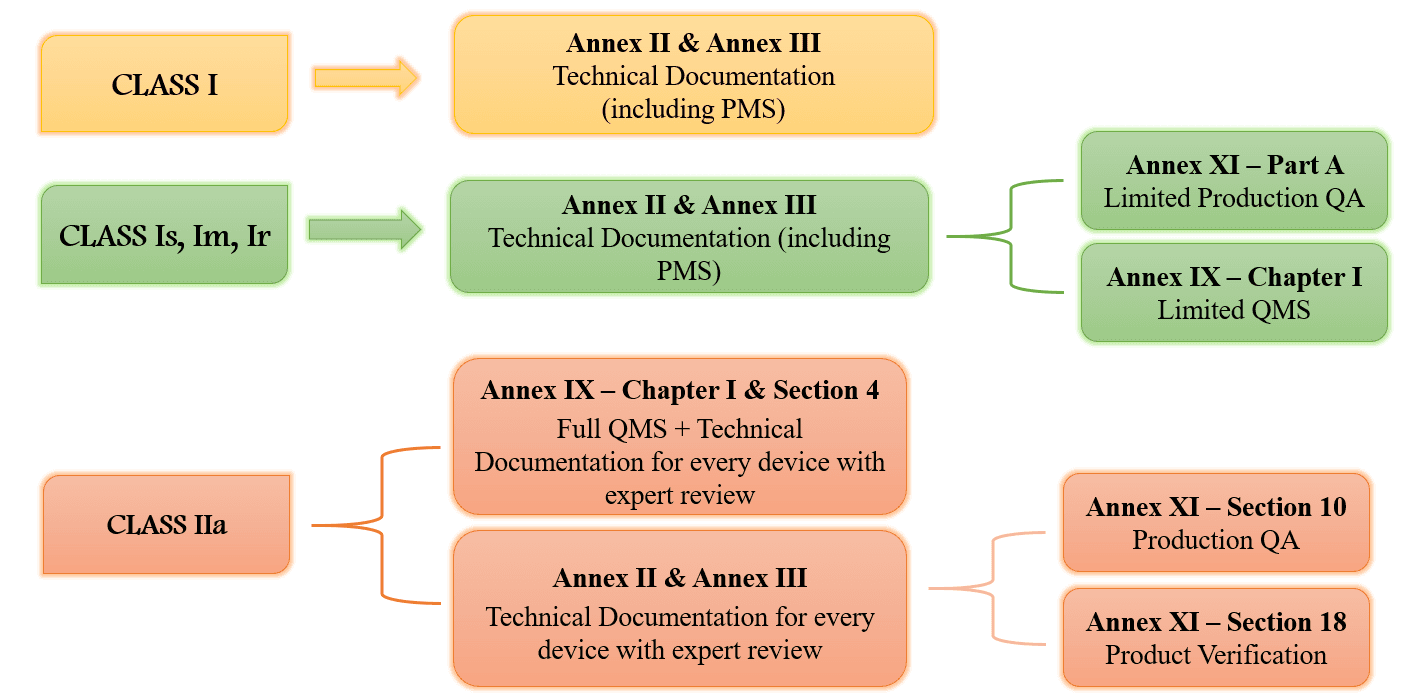
The only route for a self-certified Class I medical device is to maintain technical documentation in compliance with Annex II and III.
In addition, for the Class I device supplied sterile (Is), with a measuring function (Im), or reusable surgical instruments (Ir), a limited QMS must be in place to control the production (Annex XI Part A) or to control the special characteristic (e.g., sterility, measuring, reusable features) (Annex IX – Chapter I). For Class Is, Im and Ir devices, a NB will be involved to control how the QMS manages those specific features in regard to the conformity assessment procedure selected.
However, for these types of devices the intervention of the NB is limited to:
- metrological aspects for class I devices with a measuring function
- aspects related to establishing, securing and maintenance of the sterile conditions for Class I devices placed on the market in a sterile condition
- aspects related to the reuse of the device (cleaning, disinfection, sterilization, maintenance and functional testing and related instructions for use).
However, parts of Technical Documentation relevant to sterilization / metrology / re-use aspects outlined above may be audited as part of audit activities.
Class IIb, III conformity assessment procedure
Class IIa devices
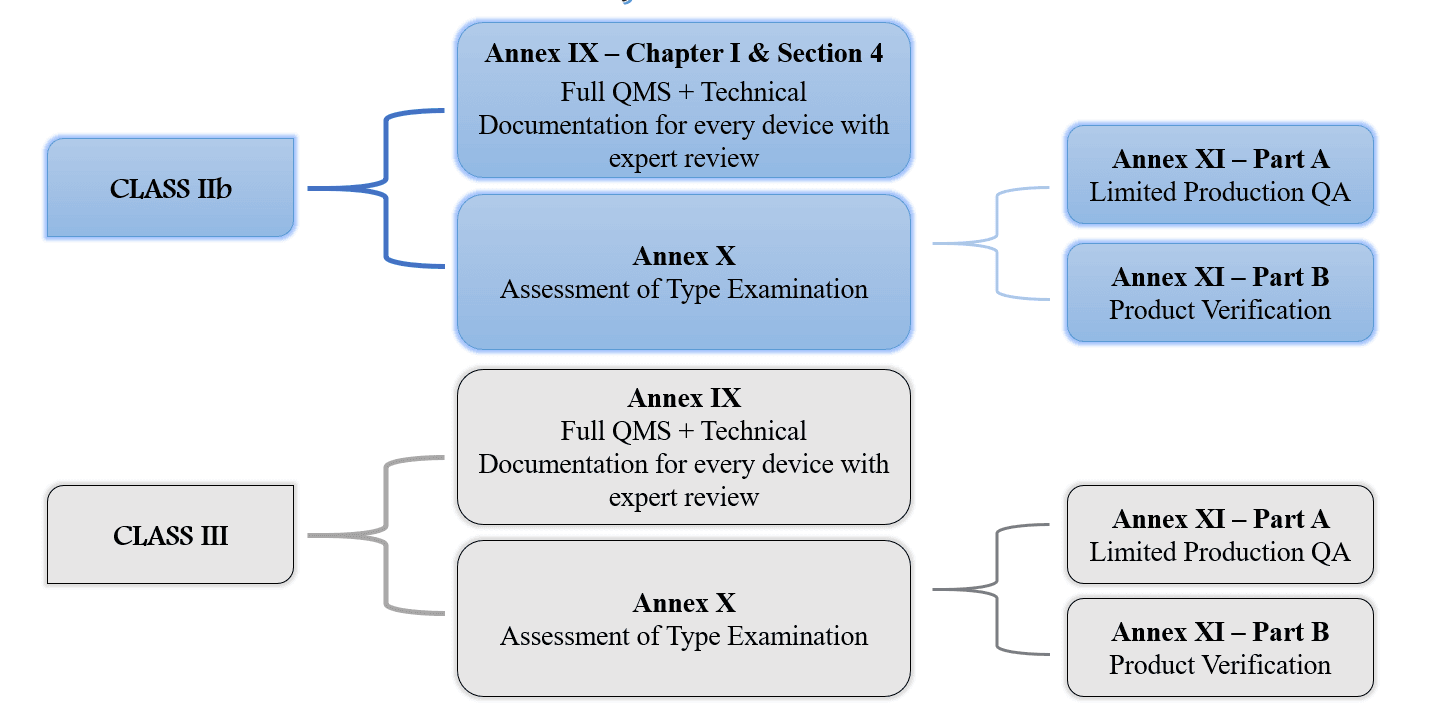
The conformity assessment procedure for a Class IIa device through the review of full QMS (Annex IX) is identical to the procedure for a Class IIb non-active and non- implantable device. Alternatively, a manufacturer may build technical documentation aligned with Annex II and III and select a route of conformity assessment based on the production control (Annex XI).
Class IIb devices
Class IIb devices should be considered part of one of the following categories:
- Class IIb implantable device
- Class IIb active device intended to remove or administer medicinal substances
- Class IIb device not included in the categories above
For Class IIa, IIb, and III medical devices, conformity assessment involves a combination of Quality Management System (QMS) audits, technical documentation reviews, and device testing, depending on the selected conformity assessment route. Additional procedures, such as consultations with regulatory authorities, may be required for certain device types. QMS assessment includes on-site audits of the manufacturer's facilities and, where necessary, those of relevant suppliers and subcontractors.
Class III implantable devices; and Class IIb active devices intended to administer or remove medicinal substances under rule 12
The Clinical Evaluation Consultation Procedure (CECP) under MDR Annex IX, Section 5.1 applies to certain high-risk devices. During this process, the Notified Body (NB) submits the Clinical Evaluation Report and supporting documentation to the European Commission’s Expert Panel. The panel may issue a scientific opinion within a defined timeframe, which the NB must consider when making its final certification decision.
Devices incorporating a medicinal substance
For devices incorporating a medicinal substance, the Notified Body (NB) must conduct a consultation with the relevant national competent authority or the European Medicines Agency (EMA), as required by MDR Annex IX, Section 5.2. The authority evaluates the quality, safety and benefit-risk profile of the medicinal substance within the device.
Devices utilizing non-viable human derivatives
Notified Body (NB) must consult the relevant human tissues and cells competent authority in accordance with Directive 2004/23/EC. The authority reviews information on tissue sourcing, procurement, testing, safety and the benefit-risk profile of their use in the device and provides a scientific opinion.
Devices utilizing non-viable animal tissue/cells/ derivatives
Notified Body (NB) performs a consultation in accordance with Regulation (EU) No. 722/2012. Following its assessment, the NB prepares a Summary Evaluation Report (SER), which is reviewed by the competent authorities of EU Member States.
Devices that are composed of substances or of combinations of substances that are absorbed by or locally dispersed in the human body (Rule 21)
Notified Body (NB) must consult the relevant competent authority or the European Medicines Agency (EMA) in accordance with MDR Annex IX, Section 5.4. The authority evaluates compliance with the applicable requirements of Directive 2001/83/EC and issues a scientific opinion based on the manufacturer's submitted data.
Conformity Assessment under EU IVDR
Under the In Vitro Diagnostic Medical Devices Regulation (IVDR) (EU) 2017/746, the assessment route depends on the device's classification, intended purpose and associated risk level. Selecting an incorrect route can result in regulatory non-compliance, certification delays, or restrictions on market access.
IVD Device Classification
IVDR classifies IVDs into four risk-based categories:
- Class A: Low individual and public health risk (e.g., laboratory equipment and specimen receptacles).
- Class B: Moderate-risk devices not covered by other classifications.
- Class C: Devices presenting a high individual risk or moderate public health risk, such as certain cancer screening and diagnostic tests.
- Class D: Devices associated with the highest individual and public health risks, including tests used to detect transmissible infectious agents in blood, tissues, or organs.
Conformity Assessment Routes
Class A Devices
Most Class A devices may undergo manufacturer self-declaration of conformity without Notified Body involvement. However, Class A sterile devices require Notified Body assessment for aspects related to sterility.
Class B Devices
Class B devices require Notified Body involvement through:
- Annex IX: Quality Management System (QMS) assessment and technical documentation review, or
- Annex X and Annex XI: Type examination combined with production quality assurance or product verification.
Class C Devices
For Class C devices, Notified Body assessment is mandatory and includes:
- Annex IX: Full QMS assessment, technical documentation review, and evaluation of performance data, or
- Annex X and Annex XI: Type examination together with production quality assurance or product verification.
Class D Devices
Class D devices are subject to the most rigorous conformity assessment requirements, including:
- Annex IX: QMS and technical documentation assessment, together with involvement of EU Reference Laboratories where applicable, or
- Annex X and Annex XI: Type examination and production assurance, including additional verification and testing requirements.
MEDREG help medical device and IVD manufacturers understand the complexities of EU MDR and EU IVDR conformity assessment. From selecting the appropriate assessment route to preparing technical documentation and supporting Notified Body interactions, we provide regulatory guidance tailored to your device and its classification.
- Regulatory Pathway Selection: Identify the appropriate conformity assessment route based on your device classification and applicable regulatory requirements.
- Notified Body Coordination: Get support in identifying suitable Notified Bodies and preparing application documentation.
- Technical Documentation Support: Prepare and review regulatory documentation to demonstrate compliance with applicable requirements.
- QMS and Audit Readiness: Strengthen your Quality Management System and prepare for Notified Body audits.
- Non-Conformity Resolution: Receive assistance in addressing assessment findings, preparing corrective actions, and responding to Notified Body queries.
- Post-Certification Compliance: Maintain regulatory readiness through ongoing documentation updates and post-market compliance support.